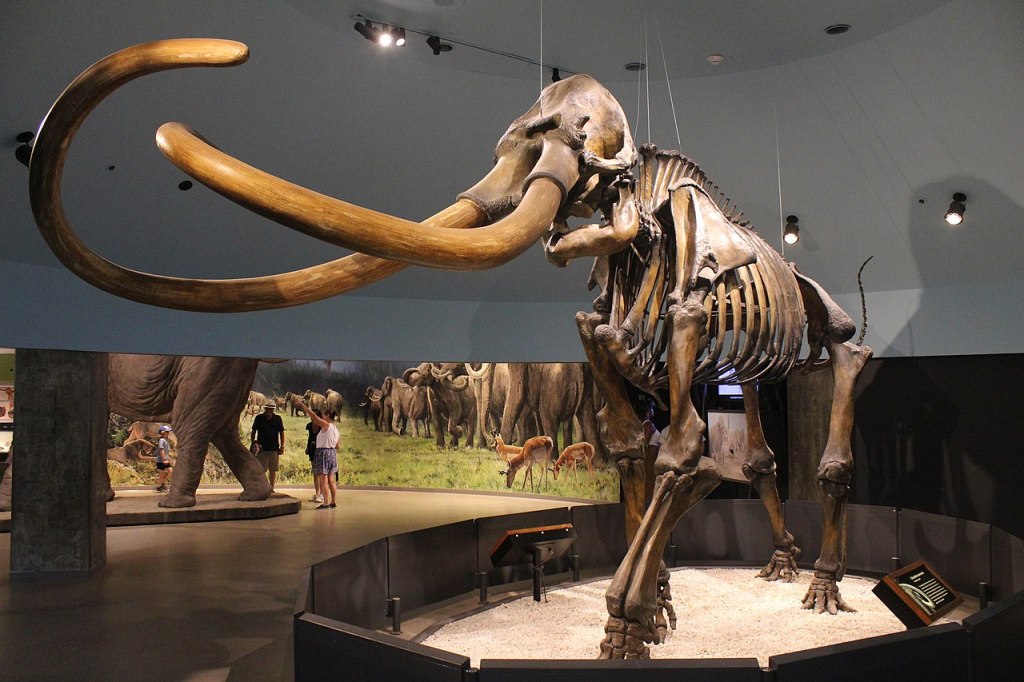
It’s dawn in America and you and a friend have woken up early to summit a craggy peak and get a good look at sunrise over the great valley below. In these early dawn hours, an unmolested array of stars shine overhead until the first glow of the eastern horizon’s pink begins to obscure them. It’s cold but not unbearably so.
You arrive at the top and take a seat on a rock. The light of the sun begins to accentuate the shadows of patchy trees, but these trees do not dominate the landscape. Instead, a vast plain of grass stretches below, interspersed by rocks that signal a slow and ancient violence on the landscape. On the far horizon to the north, the faint blue of a wall of ice trims the sky. In the valley, a herd of deer drink from a stream that by all means looks incredibly refreshing. Some distance from them, bison chew on grasses in huge numbers. A loud rumble echoes through the valley and the bison move forward to make way for a massive Columbian mammoth, its solitude and size suggestive of a male, which then goes to feed on a choice patch of grass. A lookalike creature, a mastodon, browses nearby in a patch of trees, pulling branches from them. On a rock, a pair of female lions relax and look at the view, the other animals giving them a wide berth. Eagles circle overhead, hunting rodents below.
In a few thousand years, this world will be changed. The ice will be gone and forests will close in on more of the landscape. The people will be more plentiful in the land and so many of the animals will be gone. Ancient America will undergo a remaking that will leave paleontologists, archaeologists, and climatologists puzzling together.
Nature’s Menagerie
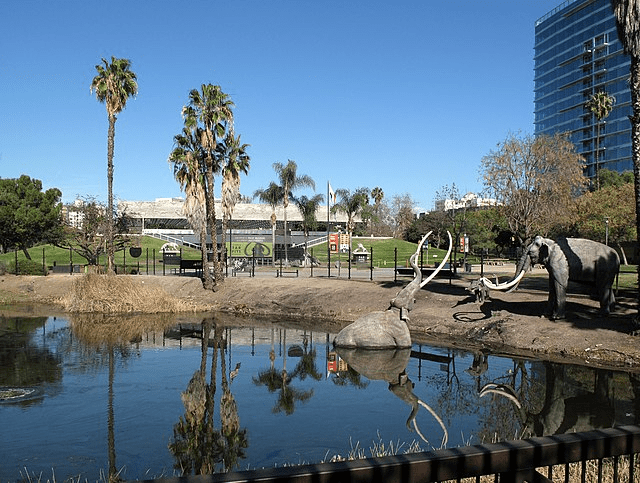
A photo of the Lake Pit out front of the La Brea Tar Pits Museum, taken by Wikimedia contributor Downtowngal. This particular lake was created by the leakage of liquid asphalt mining operations in the late 1800s which then collected a layer of water on top of it. It has been more recently decorated with the statues of Columbian mammoths, whose actual bones have been found at the site.
When I was younger, I would often visit family down in Southern California. There were the obvious places to go such as Disneyland in San Diego where a good time was had by all, despite exorbitant prices and extended lines. A good time was not necessarily had by all at the other attraction that I would always drag us to, year after year, which despite the disinterest of some of my cousins was and is my favorite tourist site in the state. That place is the La Brea Tar Pits, located right in Hancock Park on the Miracle Mile of downtown Los Angeles. On one of the most famous shopping streets in the entire USA, it is possible to stop into the pleasant museum at the tar pits, surrounded by what are indeed still pools of liquid asphalt, which is what the “tar” really is. Inside, an incredible array of extinct animals mounted in skeletal form, accompanied by lifelike animatronics, bridges the temporal gap between guests and a lost world. In terms of human history, imagining yourself, say, 25,000 years ago feels like a massive jump. In terms of natural history though, the landscape is almost familiar, like a view of the open wild spaces of the American West with some of the cast of characters switched out. It really was not that long ago that we lost the mammoth or the ground sloth or the saber-toothed cat. In fact, by the time the tar pits stopped taking in this bounty of Pleistocene animals, members of our species had already been to the site and seen the natural world there. In another fact, they have not stopped at all in reality except that humans started mining them and built Los Angeles around the still active site and changed the environment dramatically; the seepage of asphalt still poses certain risks there today and the tar pits are not dead. They are even subject to the study of the current bacterial micro-environment of a surface petroleum field, a sort of biome that I did not even think about having existed until I happened upon it during research.
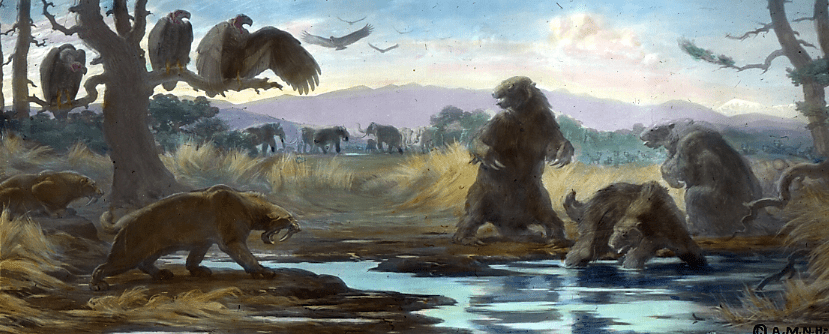
A 1921 mural by the famous paleoartist Charles R. Knight for the American Museum of Natural History in New York City displays a scene at the La Brea Tar Pits where a group of the saber-toothed cat Smilodon bears down on a trapped ground sloth Paramylodon.
The La Brea Tar Pits sit atop the Salt Lake Oil Field, which dates to around the late Miocene Epoch (about 23 to 5.3 million years ago) and consists of the pressurized ancient marine life that got turned to petroleum after this region of Los Angeles, then off the coast and sitting on the continental shelf, got buried by a large amount of sediment. Closer to the present, this area was uplifted above the shoreline and then about 50,000 years ago shifts in the famous fault line Los Angeles sits on broke open the store of fossil fuels and caused some of them to start seeping up through cracks in the rocks, creating pools on the surface, which we recognize as the tar pits today. Thick unrefined natural asphalt is denser than water and the pools would collect a layer of water on top of them which would naturally entice animals to the site, looking to get a good drink. Those that made the mistake of stepping too deep might find themselves stuck in a natural trap where they would struggle and die, attracting quite a few carnivores along the way, which do make up a disproportionate number of the bones at the site. In this way, 50,000 years of Southern California’s animal life has been preserved in a rich record that has yielded thousands upon thousands of paleontological remains. The Pleistocene, more colloquially called the Ice Age, which ended around 10,000 years ago was home to a vast array of animals that have been found at the site and, indeed, across North America. Giving an exhaustive list is impossible but we can take our time to enjoy some of the stars. We will focus in this article on megafauna, a term which varies wildly in applied definitions and inclusions but generally refers to land animals weighing more than 45 kilograms.
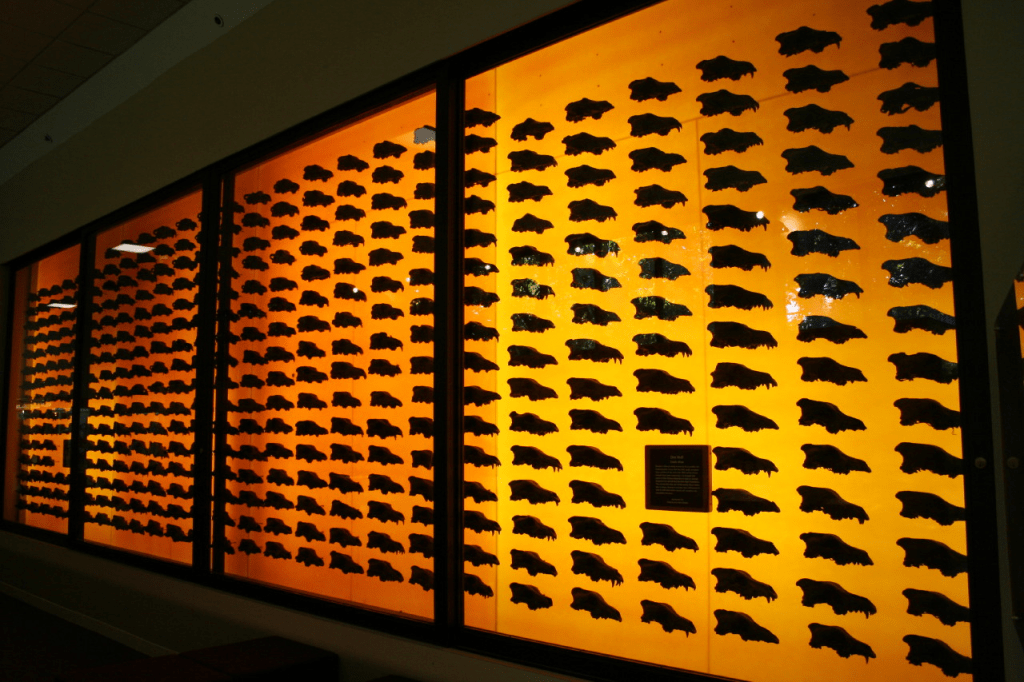
A display of hundreds of dire wolf skulls at the La Brea Tar Pits in a photo by Wikimedia contributor Pyry Matikainen.
Since we started our discussion with the La Brea Tar Pits, it is only fitting that we start with the animal the site provides more disproportionate evidence from than almost any other, the dire wolf or Aenocyon dirus. Those who grew up reading about paleontology may remember this predator being in the genus Canis along with modern wolves and domesticated dogs but reassessment of its evolutionary relationships has caused many scientists to favor putting the dire wolf in its own genus in the past few years, despite its morphological similarity to grey wolves, largely due to a lack of gene flow between the two, showing they never bred. Regardless, these large canid predators were incredibly common in Pleistocene North America and probably indigenous to it unlike the ancestors of modern grey wolves and coyotes who came to the continent via Beringia. Appearing in the fossil record from some 250,000 years ago, they were perhaps the most plentiful predatory megafauna on the continent; at Rancho La Brea alone, more than 4,000 individuals have been discovered, outnumbering grey wolves by more than a factor of 100. They thrived in the temperate plains environments of North America and even parts of South America, not being particularly creatures of boreal forests like their modern wolf counterparts. Weighing between 60 and 70 kilograms when fully grown, they were specialists in feeding on very large herbivores.
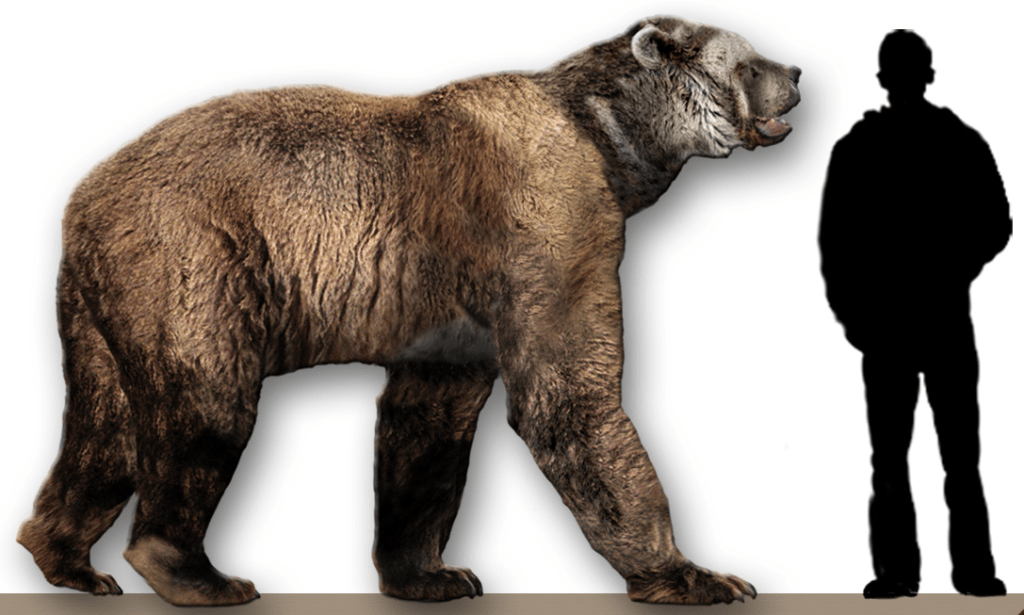
Comparison of a short-faced bear (Arctodus simus) with a human by Wikimedia contributor Dantheman9758.
And then there was the largest bear that ever lived. Arctodus simus was one of a few types of bears that are given the title of “short-faced bear” and is the one that is meant in discussions of North America. The short-faced bear was large enough that when standing on all fours, it could look an adult human in the eye. Historically, it was assumed that the short-faced bear occupied a more predation-focused niche than its longer-faced grizzly contemporaries and that it was a carnivore but recent studies on the animal have noted that it lacks a lot of adaptations associated with assault predators and that it seems to have incorporated heavy plant material in its diet, eating meat as well through scavenging. It therefore had a diet not all too different from most of the other bears that live in the continental US today, albeit it was a lot bigger. This species of short-faced bear was widely distributed across North America, including up to Beringia.
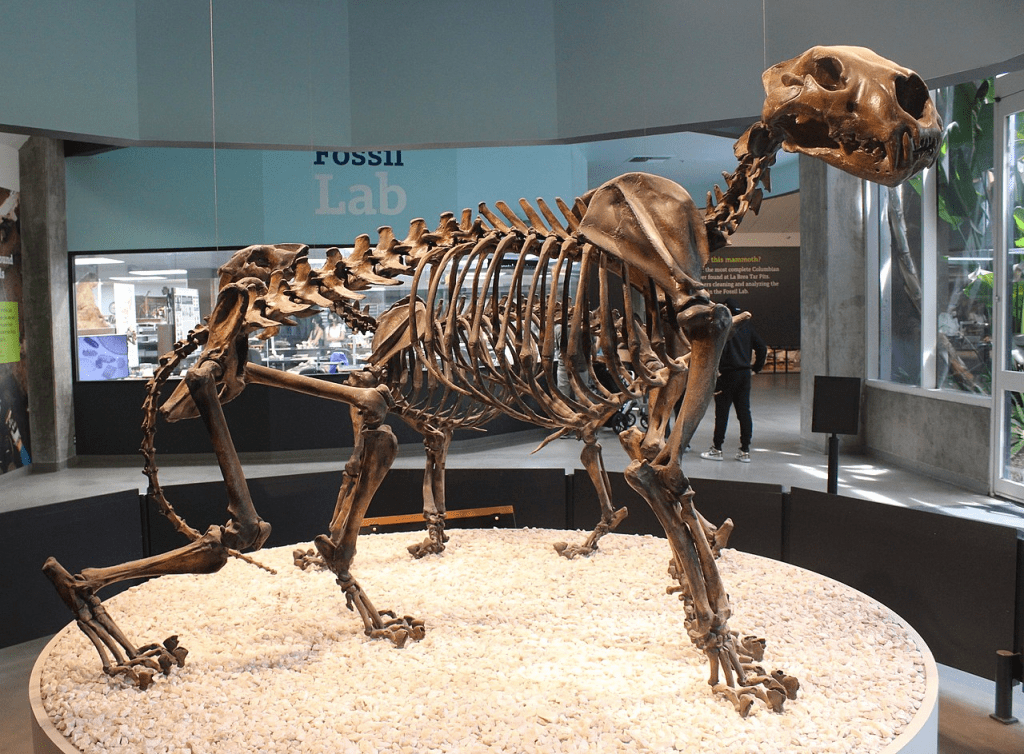
American lion at the La Brea Tar Pits in a photo by Wikimedia contributor Jonathan Chen.
Also among the carnivorans of Pleistocene North America was the American lion, Panthera atrox, which was quite similar to its modern African cousin and a member of the same genus. That said, they were somewhat larger and some of the largest cats of all time, which does fall in line with Bergmann’s rule, a tendency among related animals to be larger in colder climates. American lions were apex predators and evidence shows that they ate well. Studies of the wear on Pleistocene lion teeth indicate little evidence of feeding on rough material like bones, showing that the individuals were able to sustain themselves well on the choice parts of carcasses, which is suggestive of a plentiful prey environment. They are certainly not the most iconic cat of Pleistocene North America however…
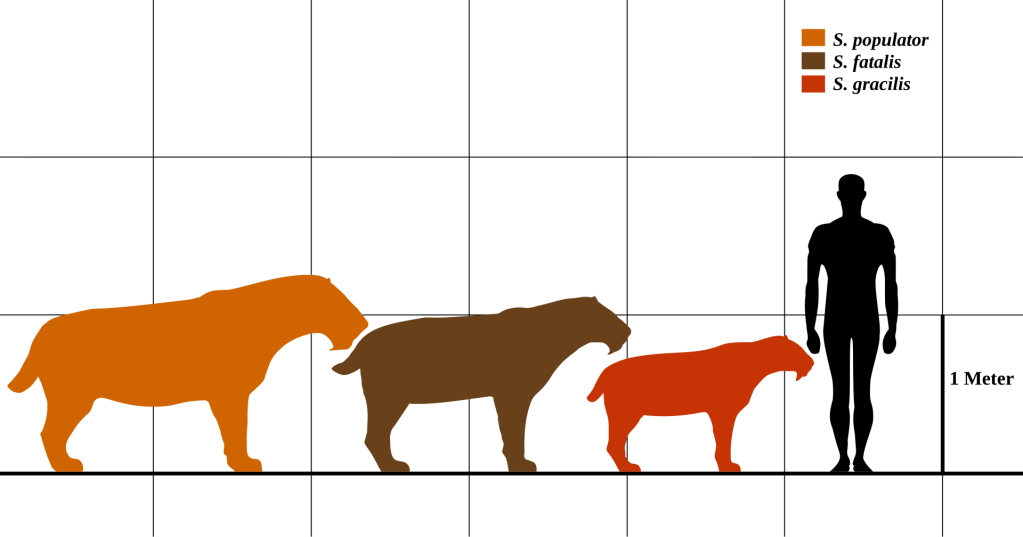
The three known species of saber-toothed cat of the genus Smilodon compared with a human in a graphic by Wikimedia contributor Alhadis. S. populator was from South America whereas S. fatalis and S. gracilis were from North America.
Saber-toothed cats were actually a whole group of extinct felids known as the machairodonts, a clade that has no living representatives. The most famous genus of the group is Smilodon, which originated in North America but actually crossed over into South America as well as a result of the Great American Biotic Interchange, the movement of organisms between the two continents that has occurred since they became connected 2.7 million years ago. The most prominent North American species of saber-toothed cat was Smilodon fatalis, which is widely present in Rancho La Brea and in much of North America. Smilodon‘s iconic saber teeth could measure up to 28 centimeters long and debates abound regarding how they were used in killing prey. One thing is clear though that Smilodon was a specialist at hunting megafauna, such as bison and horses. Compared to modern cats, these saber-toothed killers had more robustly constructed front legs and a more muscular build in general, showing that their powerful claws and strong bodies were as much the key to the animal’s deadliness as any extremely derived tooth. Despite being slightly shorter than the American lion, these cats were more muscularly built and they probably competed for much of the same prey but had some important differences that allowed them both to propagate across the continent successfully. Perhaps the diversity of herbivorous megafauna comparable to modern Africa simply allowed multiple specialized large predators to exist more easily. Let us now look at a few of those herbivores.
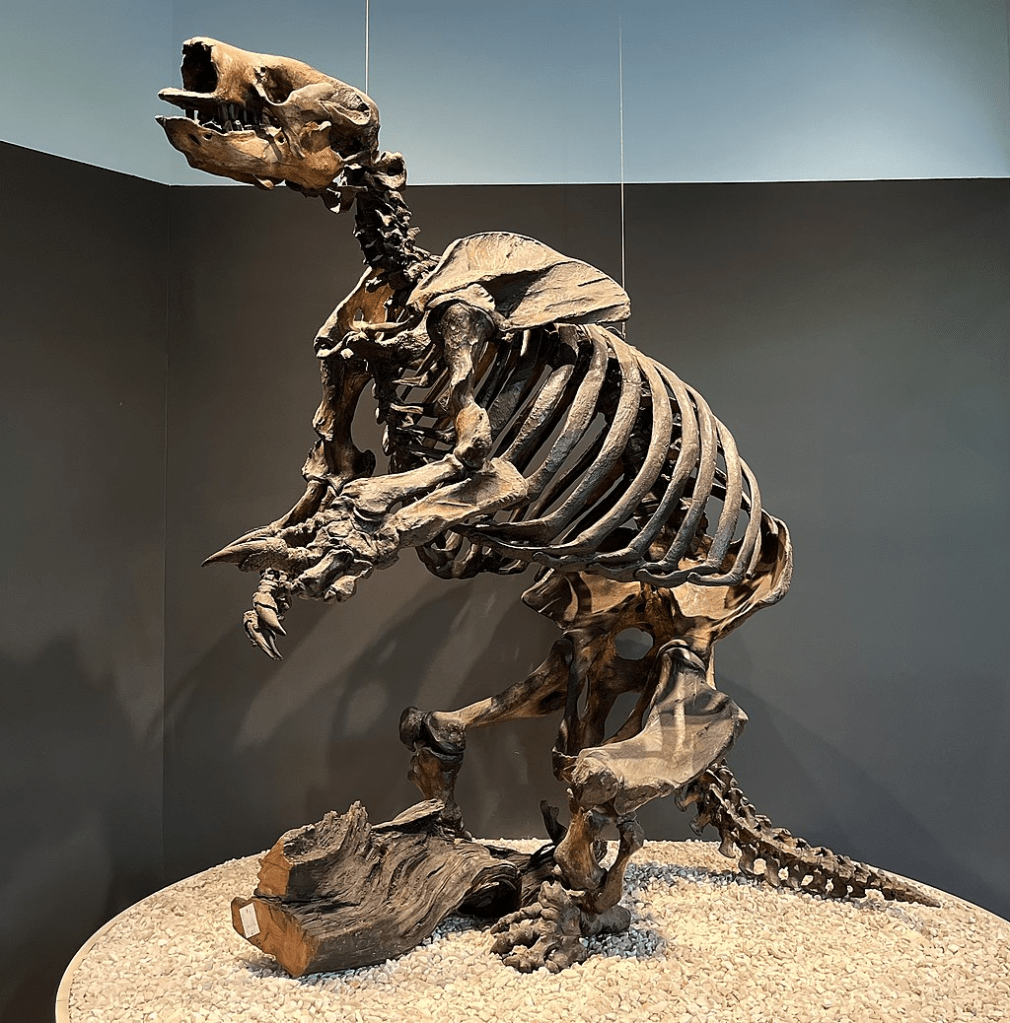
The ground sloth Paramylodon in the museum at the La Brea Tar Pits from Wikimedia contributor Nikhil Iyengar.
Animals did not move only from North to South America in the Great American Biotic Interchange but the other direction as well. Among South America’s donations to North American mammal life that still exist today are armadillos (as well as their giant extinct relatives the glyptodonts), porcupines, and opossums. But perhaps the most iconic to the Pleistocene of these South American animals to become rooted up north were the ground sloths. Ground sloths were a diverse group of many genera and species, the most famous of which was the giant ground sloth or Megatherium which was restricted to the plains of the southern and central parts of South America but could reach weights of up to 4,000 kilograms, approximately the same as a modern Asian elephant. Those ground sloths which moved into North America were smaller but still quite large, such as 1,500-kilogram Paramylodon or Harlan’s ground sloth, which showed some significantly derived tooth differences from its South American ancestors. As the ground sloths propagated in North America, they appear to have moved into increasingly more open environments and developed adaptations for digging. The sloths were therefore adapted to tear their way through and consume abrasive plant material that many grazing animals wouldn’t touch so much.
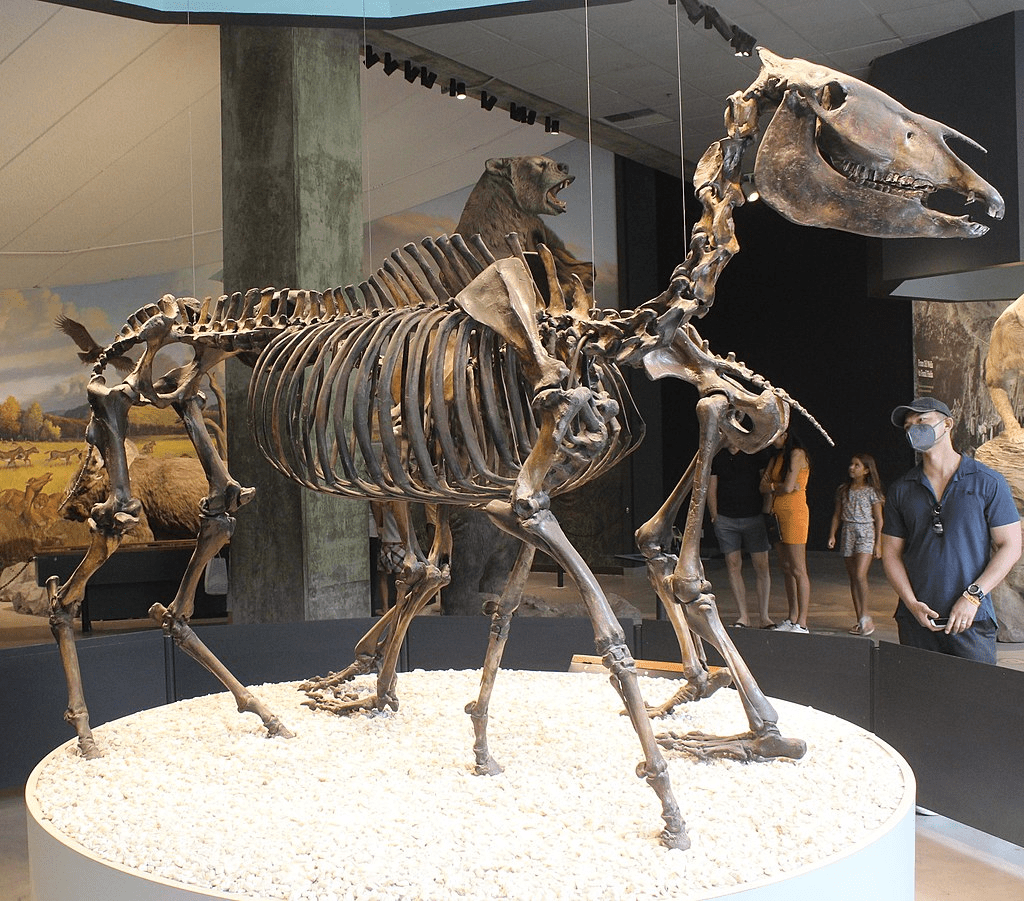
The skeleton of a western horse from the museum at the La Brea Tar Pits in a photo from Wikimedia contributor Jonathan Chen.
Common wisdom understands that the modern domesticated horse, Equus ferus caballus, was introduced to North America by the Spanish in the 1500s as part of the Columbian exchange. However, strangely true at the same time is that horses actually evolved in North America, dispersed to Eurasia via Beringia, disappeared in the Americas, and then were reintroduced by these conquistadores. In the Late Pleistocene, a related species of horse still lived in the American Southwest which has been called Equus occidentalis or the western horse. Western horses were built sort of like modern zebras but around the size of modern domesticated horses, wandering the American range in large grazing herds. They were no doubt fast-running prey animals but a staple for many large predators and a very common presence on the landscape. Another ancient grazing local was the camel of the genus Camelops, the last of the North American camels before the Columbian exchange when they were also reintroduced to the continent. They shared ancient North American ancestors with Afro-Eurasian camels as well as South American camelids such as llamas and alpacas, both the result of dispersals out of North America within the last few million years.
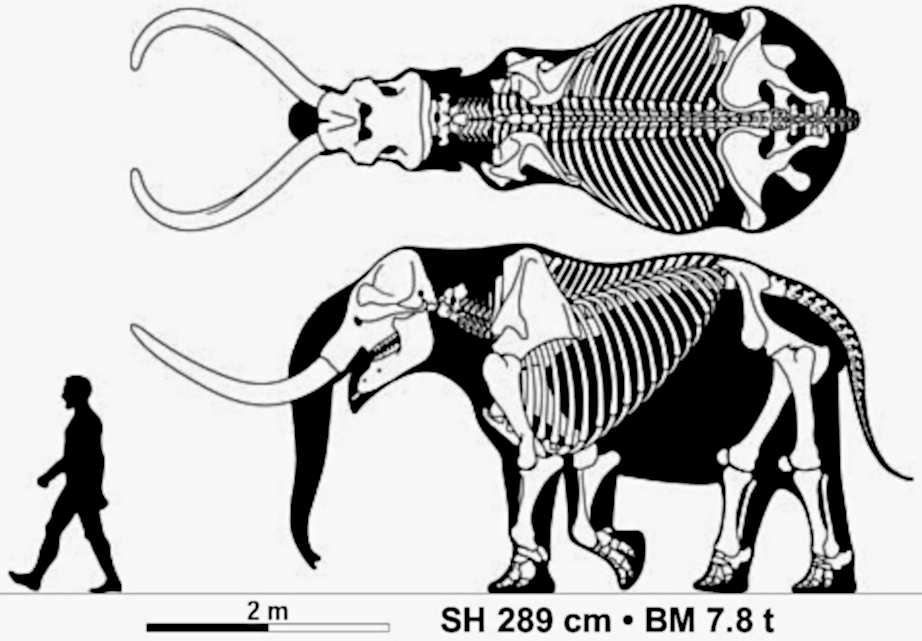
Size diagram of a specimen of the American mastodon by Asier Larramendi.
Confusingly, the scientific name Mammut americanum refers to the American mastodon and not to mammoths, which are indeed another type of animal. Mastodons were the remains of a more distant lineage of proboscideans that were not so closely related to living elephants as mammoths were. The American mastodon was in the size range of a modern African elephant but built very differently with a generally flatter back and rounder body and very different teeth. Unlike their distant modern cousins, mastodons were not grazers who fed on grass but rather browsers that had dentition suited to consume the hard woody vegetation of shrubs and trees. Proboscideans evolved in Africa and the ancestors of mastodons had come to America via Beringia from Asia but found the New World ripe for populating. Some have been found in Alaska but most lived south of the ice sheets in the temperate climates of what is now the mainland United States, where they were suited to the environments around the edges of forests.
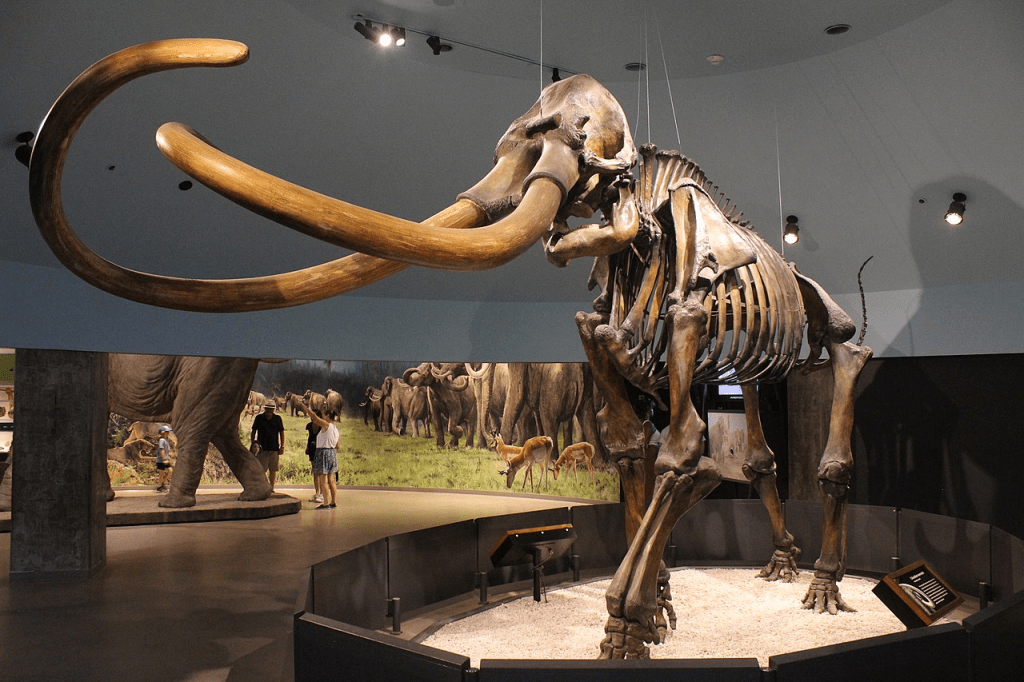
A Columbian mammoth at the La Brea Tar Pits in a photo by Wikimedia contributor Jonathan Chen.
Our tour of the megafauna ends with the most iconic genus of the Ice Age: Mammuthus. Mammoths were true elephants (in fact, mammoths are more closely related to Asian elephants than Asian elephants are to African elephants) which like the ancestors of the mastodons also came across Beringia. On the Eurasian Steppe, which was much more extensive in the Pleistocene, they had seen great success and as this steppe extended across the land bridge into North America, it was very much a natural extension of their range. Mammoths ate grass and their stomach contents have been directly studied from frozen specimens in the Arctic, since remarkably preserved mammoths have been found in the region for a very long time, meaning that we know remarkably much about these spectacular animals. North American mammoths were largely divided into two different species. The more famous of these which lived in the tundra to the north, especially in Alaska and across the Bering Land Bridge into Siberia, was the woolly mammoth, Mammuthus primigenius, which was covered in a very thick shaggy coat and was larger than a modern African elephant. However, the largest of Pleistocene North America’s megafauna was the other which lived on plains south of the ice sheets. This was the Columbian mammoth, Mammuthus columbi, one of the largest elephants that ever lived, standing at 4 meters at the shoulder and weighing in at potentially 12 metric tons. In the transitional environment between where these two lived, they clearly overlapped to an extent as genetic evidence (the genomes of both have been sequenced) indicates that there was interbreeding between the two.
Pleistocene North America was home to a truly spectacular array of large land mammals, but all of those highlighted above disappeared from its landscape in what paleontologists would consider a very short time, between 13,800 and 11,400 years ago. If you clicked on this article with a history of interest in prehistoric animals, it is likely that you have heard one of two stories about what happened to these animals. Some readers may have heard that as the glaciers retreated and the landscape warmed, animals which were adapted to the Pleistocene cold found it hard to survive in the new warmer world and that climate change drove those which were most cold adapted to die out. Other readers have almost certainly heard a murder story instead: the ancestors of today’s Native Americans entered the continent and proliferated, hunting more efficiently than any other predator before them, killing off large animals in large numbers until, after enough time, they were gone. These admittedly deeply simplified narratives are termed roughly “the climate hypothesis” and “overkill hypothesis.” Both seem like nice clean stories but both have been challenged in that cleanness. For one thing, the glaciers have retreated and returned multiple times. For another thing, the idea that humans entered North America 13,000 years ago has been disproven in the face of abundant evidence that they were on the continent even earlier. On top of this, a whole array of megafauna still exist in North America and the list of dead and survivors matches neither clean lines between those animals which were adapted to the cold or not or between those which humans hunted or not. For the rest of this article, we will explore the complexity of this prehistoric enigma.
The Mechanics of an Ice Age
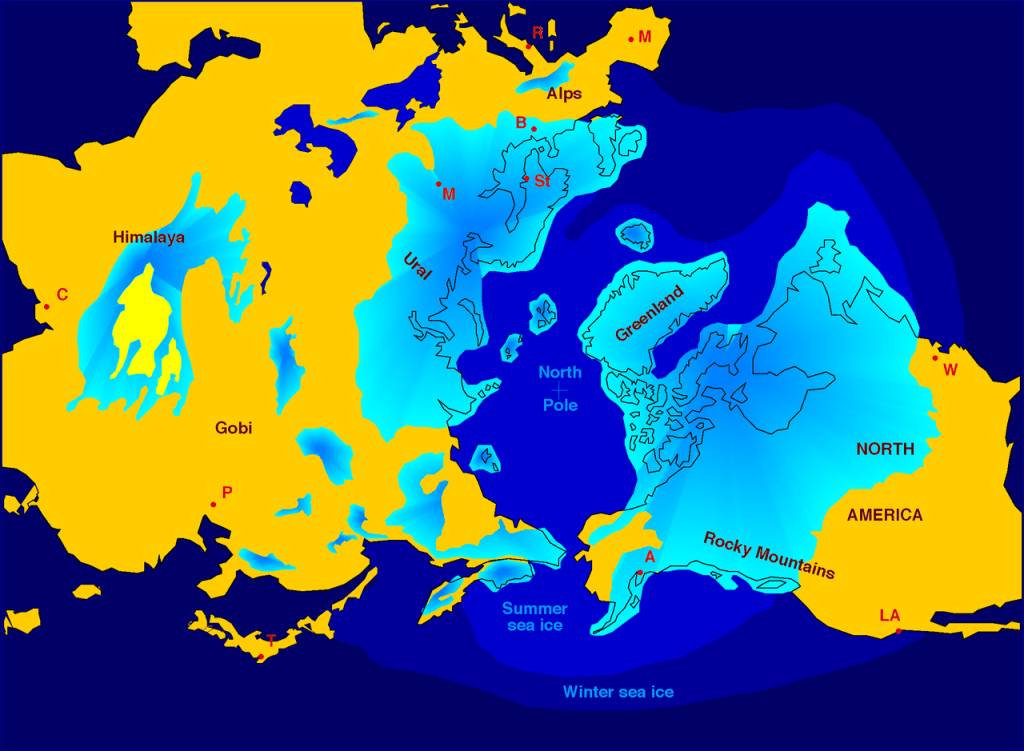
This map by Hannes Grobe represents the extent of glaciation in the Northern Hemisphere during the Last Glacial Maximum between 26,000 and 20,000 years ago. Sea level changes are not represented on this map which uses modern coastlines.
Often the Pleistocene is colloquially called the “Ice Age” and in common parlance this works fine but to understand the scientific discourse on the ice age and to talk about its relationship with the decline of the megafauna, we need to redefine the term as paleoclimatologists use it. An ice age is simply a period in the history of the Earth in which permanent year-round ice caps exist at the poles. The opposite of an ice age is a greenhouse period in which no such ice caps exist. For the vast majority of the Earth’s 4.5-billion-year history, it was in greenhouse periods. There are about six notable ice ages in Earth’s history, mostly concentrated on the more recent side, four of them happening in the last half-billion years when animal life also existed on the planet. Within an ice age, temperatures tend to vary over time. In discussing the ebb and flow of glaciation within the past few million years, the amount of available data and thus the “resolution” of reconstructions is good enough that it is possible to create a pretty good timeline of the global temperature. Temperature changes can be affected by a whole variety of things, making them actually fairly complex. These include the composition of the atmosphere (the most recognizable to modern readers because it is the relevant issue to human-caused climate change today), the proximity to the Sun and eccentricity of the Earth’s orbit, the winds and currents moving around on the surface of the planet itself, the Earth’s tilt, the ground covering and to what extent it absorbs or reflects sunlight, geological activity such as volcanoes, and more. Because there are so many factors, even though ice ages last for millions of years, they go through phases of greater and lesser intensity, which we call glacials and interglacials respectively. We are still living in the same ice age that existed in the Pleistocene but in an interglacial phase where the permanent ice caps still exist (for now; anthropogenic climate change presents an interesting situation here) but which have retracted significantly from their maximum extent. Because the Greenland and Antarctic ice sheets still exist and have existed continuously now for millions of years, by coring deep into them, it is possible to find frozen trapped air samples that provide a record of atmospheric composition through recent geologic history. Astrophysical models can reconstruct the past movements of the planet Earth through space and paleontological data from fossil and other biological remains can give clues as to what sorts of ecosystems existed in different places at different times. From all these lines of evidence, it is possible to reconstruct a history of our most recent (and current) ice age, the Quaternary Glaciation.
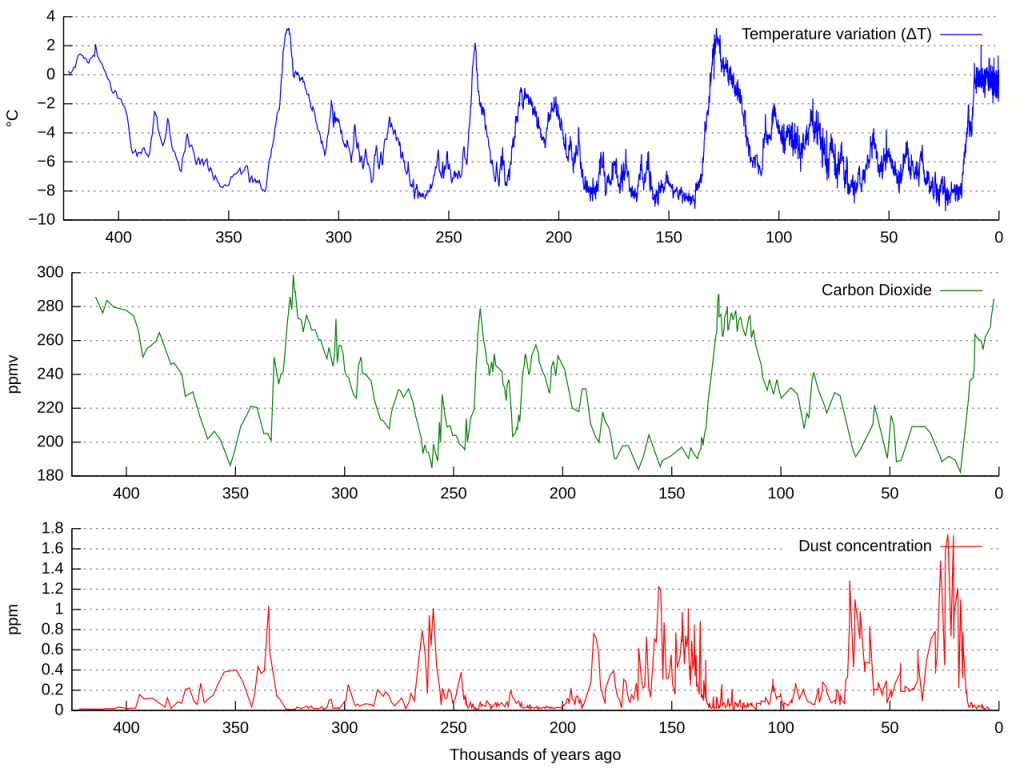
Data of the last 420,000 years collected from ice cores by Vostok Station in Antarctica and formatted by NOAA, showing the change in temperature relative to pre-industrial averages (that is, global temperatures around 1700), the carbon-dioxide concentration in the atmosphere, and the concentration of dust in the samples. The cycle of glacials and interglacials is very visible here, the most recent transition around 10,000 years ago representing the transition between the Pleistocene and the Holocene when the North American megafauna extinctions occurred.
In discussing our current topic, it is important to have some bearing on the chronology of glaciation. The Quaternary Period refers to the last 2.58 million years and is divided into two different epochs: the Pleistocene and the Holocene. These cover vastly unequal stretches of time with the transition between the two being just 10,000 years ago. The Holocene therefore is a nice shorthand for our current interglacial phase, but it is not the only comparable interglacial that has occurred during the Quaternary Glaciation as can be seen in the image above. The transition does, however, fall in line chronologically with the North American megafauna extinctions and, interestingly but less importantly here, the early phases of the Neolithic Agricultural Revolution in the Near East. Proponents of the climate hypothesis suggest that the very rapid (on geological timescales) temperature changes at the end of the Pleistocene from an intense glacial period into the Holocene interglacial matches up very well with the extinction of the megafauna. Detractors point out that these megafauna species did survive similar transitions and entire interglacial phases before. Interestingly, there is a cyclical pattern to these climate changes and to explore this, we need to talk about the Earth in space. Bear with me because this is about to get incredibly technical and I promise we will get back to prehistoric mammals.
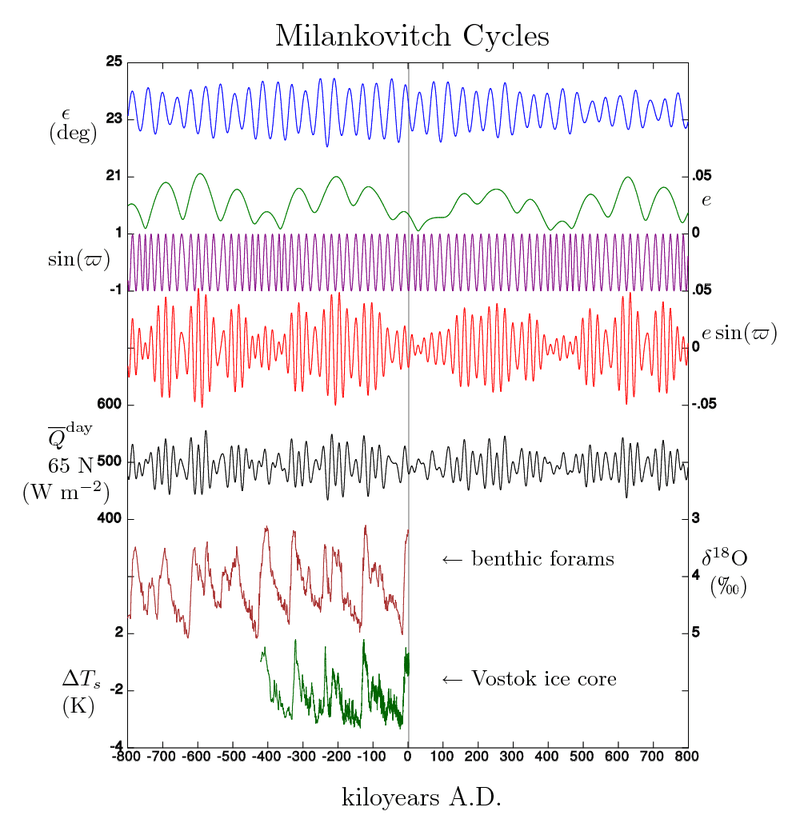
This graph synthesizing data from NASA, NOAA, and paleontological sources by Wikimedia user Incredio shows how different details related to the Earth’s orbit and tilt combine to create the Milankovitch cycles in the Earth’s temperature. Blue at the top represents the tilt of the Earth’s axis, the green underneath it is the Earth’s orbital eccentricity, purple is the longitude of perihelion (the longitude of the planet closest to the Sun), red is the precession index (the product of the axial tilt and the longitude of perihelion which together form a compound variable that correlates with the climate cycle), and the black represents the average daily insolation (energy taken in by the Sun) at the top of the atmosphere at 65 degrees north. The bottom two are the presence of benthic foraminifera (a group of small marine temperature-sensitive single-celled organisms with tiny chitin shells that preserve in the microscopic fossil record) and the average temperature based on ice-core data that also featured in the previous image.
As we all know, the primary source of energy intake on Earth is the Sun which projects solar radiation constantly in the form of sunlight. Two primary factors related to the position of the Earth in space affect the amount of sunlight it receives and where: its orbital path and its tilt. The Earth’s orbit is close to a perfect circle but not quite there. It is actually a little squished and a little off-center. In 2025, the coming year as I am writing this, the Earth will hit its perihelion (closest passage to the Sun, 147,098,450 kilometers) on January 4 and its aphelion (furthest distance from the Sun, 152,097,597 kilometers) on July 3. But these dates are not fixed and will slowly wander around the calendar year because of a process called apsidal precession by which the orientation of the orbit’s eccentricity will slowly move in its own circle around the Sun. If this is difficult without a visual representation, here is a simplified demonstration to check out: Precessing Kepler orbit 280frames e0.6 smaller – Apsidal precession – Wikipedia . The Earth’s apsidal period, the period it takes for its precession to complete a full cycle, is about 112,000 years. The degree of eccentricity itself also varies over time, less regularly than these other mechanisms and so not as part of the emergent cycle, but introducing an important factor of variation. This is due to Jupiter and Saturn pulling on the Earth and slightly misshaping its orbit. The Earth’s tilt has its own cycle, termed axial precession, in which the poles will make a small circle, slightly changing the angle of the Earth’s orientation towards the Sun at any given part of its orbit, completing the cycle every 26,000 years or so. Together, the apsidal and axial cycles create an effective composite cycle in how they overlay known as Milankovitch cycles. These cycles are tracked in a variable called the precession index in modeling. The precession index tends to have a certain correlation with fluctuations in the Earth’s temperature. In other words, the glacial and interglacial phases of our current ice age are related to the movement of the entire planet. A proponent of the climate hypothesis of the extinction of the North American megafauna might derive from this data the wild and unintuitive conclusion that these animals were killed off by timing of developments in the Earth’s orbital path and tilt that rapidly warmed the planet.
If that was a lot, don’t worry. That’s as bad as it will get. Let’s get to talking about on-the-ground effects. Let’s talk ice.
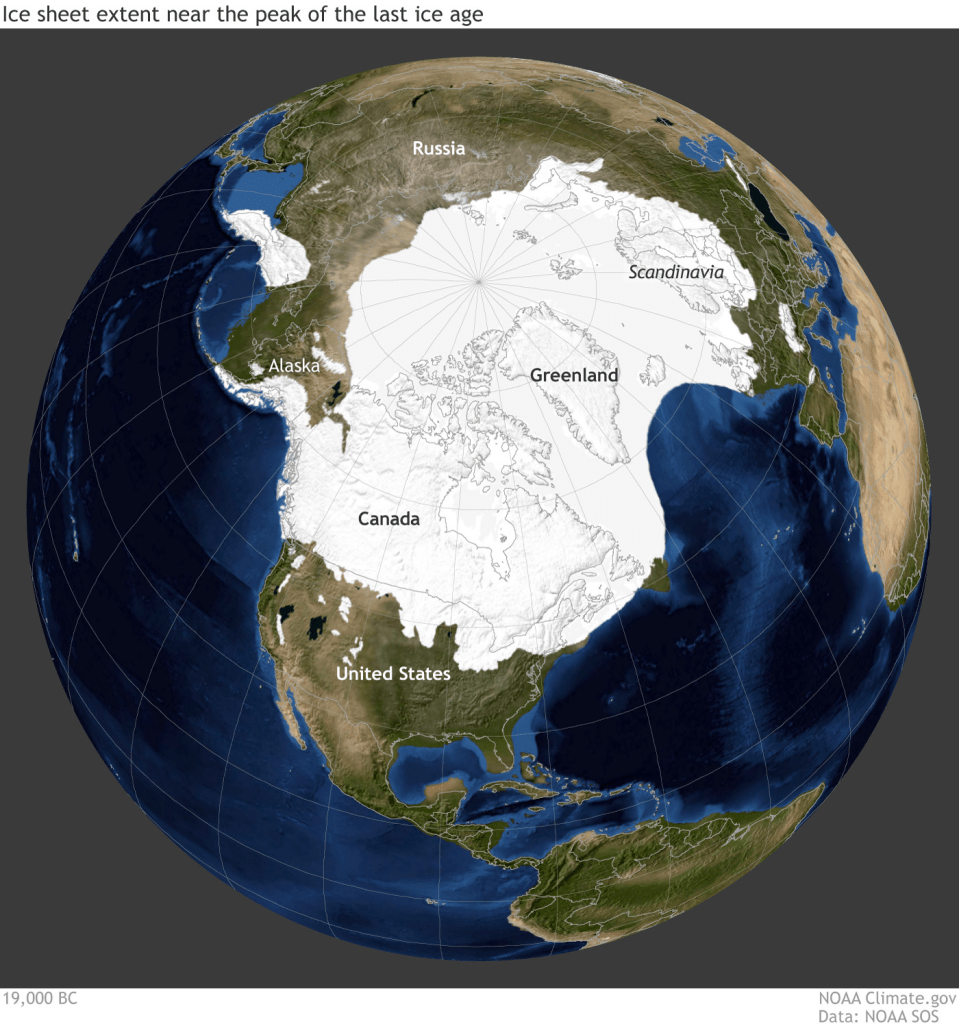
NOAA map showing the ice coverage on North America around 21,000 years ago, as well as the extent of additional land mass made by lowered sea levels.
In relation to animal life, the most important effect of the Milankovitch cycles has been how they drove developments in biogeography. During the Last Glacial Maximum, the time when the glaciation of the last glacial phase hit its most extreme extent between 26,000 and 20,000 years ago, permanent ice sheets which were in some areas multiple kilometers thick stretched far enough south in North America as to reach Vancouver Island, dig out what would become the Great Lakes, and bury New England. Most of what is today Canada was not inhabited by the megafauna at all but filled with icy wastes. Due to the amount of ice buildup, there was less water in the world’s oceans, contributing to a low point of sea levels being 125 meters below their present levels today, exposing vast areas of continental shelf in some places, which became land. The most famous such area was Beringia, a vast area of land between what is today Alaska and Siberia that essentially allowed the Eurasian Steppe to stretch into North America, with many animals crossing between the two continents seamlessly and regularly. During the Last Glacial Maximum, the land connection between Alaska and what is today the mainland United States was cut off by the connection of the vast Laurentide Ice Sheet to the east and the Cordilleran Ice Sheet to the west, but due to the fluctuating nature of ice ages, there were times when an ice-free corridor opened between the two and the dispersal of animals such as mammoths resulted from this. Today, vast boreal forests cover much of the northern latitudes but the colder annual temperature ranges of the glacial phases made this difficult due to the increased presence of permafrost in the soils. As such, steppes were a more prominent subarctic biome than boreal forests because trees had difficulty taking root. This has a lot to do with the flourishing of grazing animals in the Pleistocene.
Since the Pleistocene saw multiple interglacial phases with similar average temperatures to our own, questions have been asked by scholars in multiple fields about how particularly cold-adapted mammals survived the environmental changes that came with these developments. While many of their habitats certainly must have contracted in these phases, there would have been regions where animals like musk oxen and woolly mammoths could still find fitting habitat. After all, musk oxen still live in the Arctic tundra of northern Canada, Alaska, and Greenland and woolly mammoths themselves survived through most of the Holocene until just around 4,000 years ago in an increasingly limited range that eventually was restricted to Wrangel Island in the Arctic Ocean, once part of Beringia. Regarding the celebrated ecosystem of the La Brea Tar Pits, which was always more temperate in Southern California, local animals probably were not reliant on the distant ice at all and plenty of habitats could accommodate them. Nature is in constant flux and over thousands of years, regime changes in any given ecosystem are inevitable. Animal species which survive and endure are those which are adaptable to the need to change. One example in recent natural history is that of the cougar, which actually died out in North America at the end of the Pleistocene along with many of the other megafauna but spread back to the continent from its populations in South America. Perhaps similar regional sanctuaries helped the megafauna make it through interglacials. Scientists have also noted that high amounts of phenotypic changes do not seem to have occurred in reaction to interglacial periods and whatever evolutionary selective pressures these warmer phases inflicted on megafauna were largely survivable and reversed by the generally longer return of the cold.
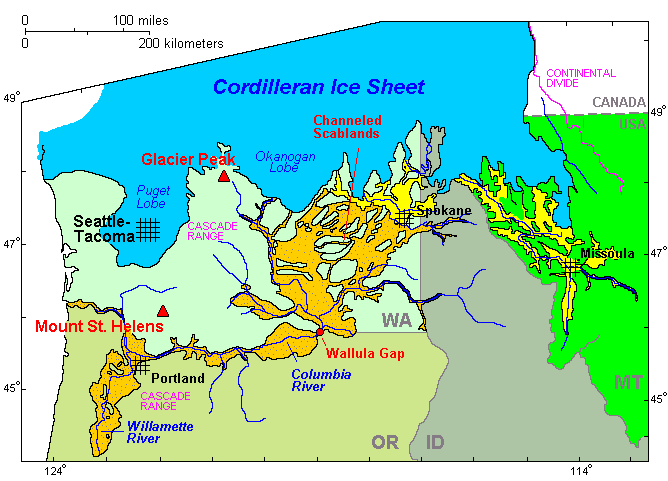
A map of the areas affected in the Missoula floods in orange as well as the area in yellow that consisted of an ancient lake system from melted glacial ice. Graphic by the United States Geological Survey.
After 20,000 years ago, the ice sheets saw a slow decline for the next 10,000 years. The glaciers did not always go calmly, as seen in the case of the Missoula floods between 15,000 and 13,000 years ago. At times, the melting ice would accumulate large reservoirs of water blocked behind walls of ice at the southern extremities of the glaciers. The breaking of these ice dams could precipitate a colossal torrent of water upon the landscape. Lake Missoula was one of these vast glacial lakes, located in what is now western Montana, which accumulated a water volume roughly equivalent to half of that of modern Lake Michigan. Several times over a 2,000-year period, ruptures unleashed vast floods that poured into what is now the eastern part of Washington State, forming the water-worn landscape there that is now called the Channeled Scablands, full of channels carved out by sudden water movement. Millions upon millions of megafauna must have died a horrible watery death in the region as their entire habitats were wiped away. This water wound its way into the drainage basin of the Columbia River, which now forms the border between Washington and Oregon, flooding it severely, even pushing up the Willamette Valley south of where Portland is today. Eventually via the Columbia, much of the water would find its way to the Pacific, forming a delta through the massive deposition of sediment. Regional floods like these were definitely not the cause of the megafauna extinction but they are fascinating examples of unique natural disasters that resulted from the retreat of the glaciers.
Around 14,500 years ago, the rise in sea levels sped up dramatically as the ice melted more and more, including a significant reduction as well in the Antarctic Ice Sheet. Old coastlines were obscured by rising waters and old connection points like Beringia were drowned. While the trend was towards warming, there was also a phase known as the Younger Dryas between 12,900 and 11,700 years ago where the process reversed and there was a temporary cooling trend, particularly in the North Atlantic region. This phase lines up with the period when most of the megafauna extinctions happened, though they started earlier and continued afterwards as well. It bears a brief mention of an alternative hypothetical explanation for the extinction of the megafauna and for the cause of the Younger Dryas altogether: a comet impact. Several decades ago, researchers in the wake of learning the dinosaurs had died in a catastrophic extraterrestrial collision proposed that the Late Pleistocene may have had one too, exploding over the Laurentide Ice Sheet in North America and plunging the world into a long winter while wiping out a great many animals. This hypothesis never caught traction in academia because it was highly inconsistent with paleoclimatological, paleontological, and archaeological information from the period while specific indicators of such an impact have never been found. Nevertheless, it has become popular in especially less-than-scientific treatments of the Late Pleistocene online and in fringe-archaeology books. Because it is unevidenced, it will not get more than this brief acknowledgement here. As scientists have studied the patterns of ice ages more, it appears the Younger Dryas was a rather typical climatic fluctuation and may have related to more mundane causes, such as changes in ocean currents.
After 10,000 years ago, the glacial phase was over and the Holocene began. The vast ice sheets were gone from North America and replaced with extensive boreal forests. Gone as well were so many of the large animals. The climate hypothesis notes the dramatic environmental changes that accompanied the deaths of these animals but it also suffers from the explanatory difficulties of why the extinctions had not happened during previous interglacial phases. Scientists therefore have different things to say about the role of climate. But there is another change that happened in North America that I have thus far glossed over. And this change is at the central focus of the other major hypothesis. For some time before the end of the Pleistocene, North America had come to be peopled.
The First Americans
If you have heard a relatively non-recent or out-of-date version of the overkill hypothesis, you probably have heard that “the megafauna extinctions in North America all happened rapidly after humans settled the continent.” If this were the case, it might suggest a very clean explanation for the extinction of the megafauna, a blitzkrieg by the most effective predator that ever lived: Homo sapiens. For much of the later 1900s, the peopling of the Americas was generally tied to the Clovis archaeological culture about 13,000 years ago, making this timing exceptional. But evidence has been accumulating for decades now to the point where we can confidently say that humans were on the continent for at least almost twice that long. The world continues to be complicated.
The ancestry of Native Americans has been wondered about even longer than there has been an academic treatment of the subject of extinction with various proposals ranging from considering them a lost tribe of ancient Israel to the descendants of ancient trans-Atlantic seafarers from Western Europe. But thanks to genetics and archaeology, we can happily throw these away in the face of overwhelming evidence: the ancestors of today’s Native Americans crossed from Siberia via Beringia. Studies of mitochondrial and y-chromosomal DNA among Native Americans have found shared genetic heritage with indigenous people in the Altai region of southern Russia, which today borders Kazakhstan, China, and Mongolia. This region has been inhabited by Homo sapiens for at least around 42,000 years and seems to have been a key passage area in the peopling of Central Asia, which accelerated at this time probably due to technological developments regarding clothing which enabled people to move into colder northern latitudes. In the Pleistocene, this meant moving onto the vast steppes where mammoths and other megafauna grazed and migrated. These steppes stretched eastward into Beringia and across into Alaska.
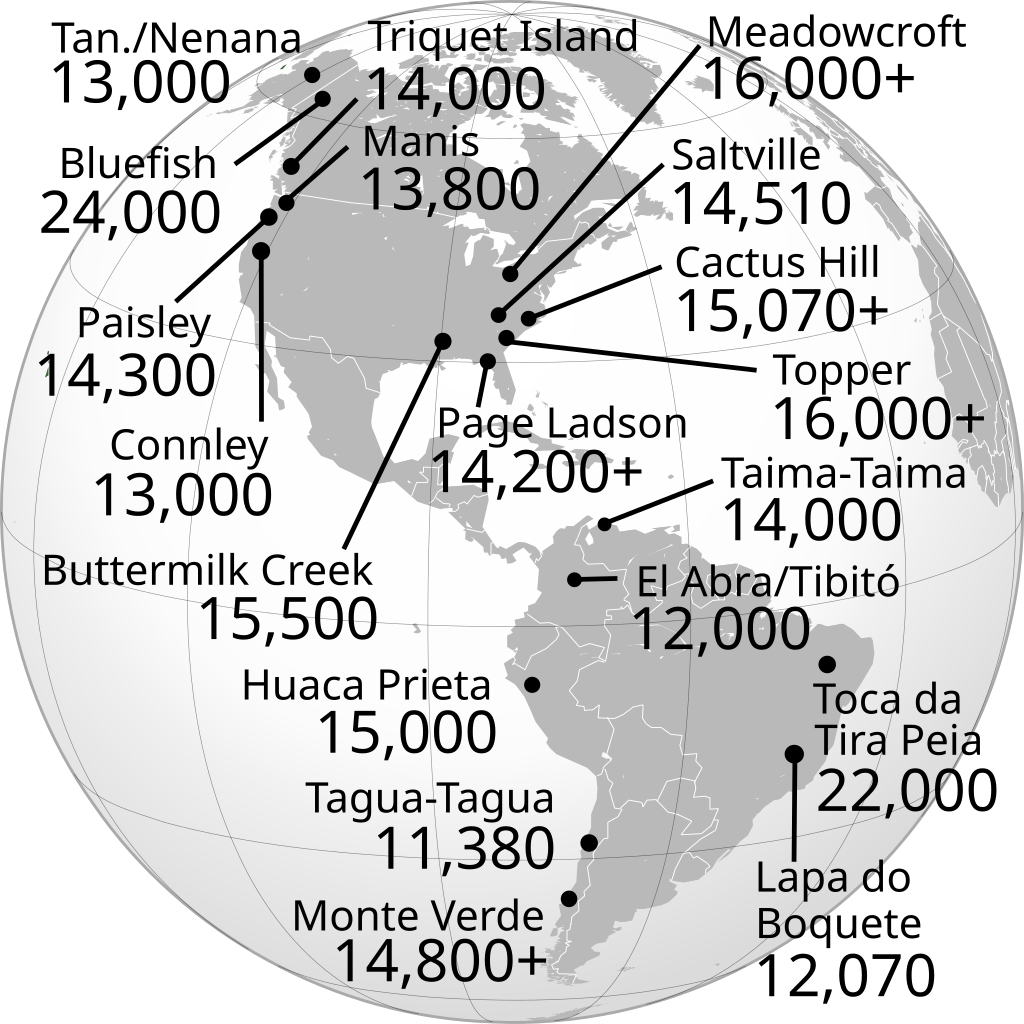
Some archaeological sites in the Americas with dates that have collectively challenged and overturned the “Clovis-first” hypothesis that the Clovis archaeological culture (13,050-12,750 years ago) represents the earliest culture in the Americas. This graphic is by Wikimedia contributor Pratyeka.
The timing of the peopling of the Americas has shifted dramatically within the past few decades as archaeologists have found more and more dates that challenge the “Clovis-first” position. Well-accepted studies now push the entrance of humans into the Americas back to at least 25,000 years ago. Even Monte Verde in southern coastal Chile provides dates older than any North American Clovis material and the East Coast of North America has similarly dated material, showing that humans had already propagated to all corners of the Americas long before the end of the Pleistocene, those areas that were buried under massive glaciers excluded. Some dates up to tens of thousands years earlier that even this have also been proposed based on dubious claims of fire pits or butchered animal bones, though none of these have become uncontroversially accepted. Assuming a date around 25,000 years ago is accurate, it also demands its own change to the process of how humans moved onto the continent. If Native Americans had come to North America towards the end of the Pleistocene as previously assumed, it would have allowed for an ice-free corridor between the Laurentide and Cordilleran ice sheets that humans could have wandered down as an inland passageway from Alaska to the mainland US. But 25,000 years ago would put the first Americans in the midst of the Last Glacial Maximum when such a passage would have been closed. To explain a relatively rapid dispersal that is more consistent with newer paradigms, a new model has been proposed in the “kelp highway” hypothesis which takes into account the rich ecosystem that existed in the kelp forests off the Pacific coast and suggests that humans moved into the Americas following the shoreline, settling on exposed parts of ancient shore aside of the massive ice sheets and making intensive use of marine resources. This idea is somewhat difficult to test considering that the rise in sea levels has obscured the coastal habitats where these people would have lived, though proponents of the idea, which I am partial to, point to lines of DNA evidence and more controversially similar tool morphologies around the Pacific rim, suggesting a line of coastal relationships.
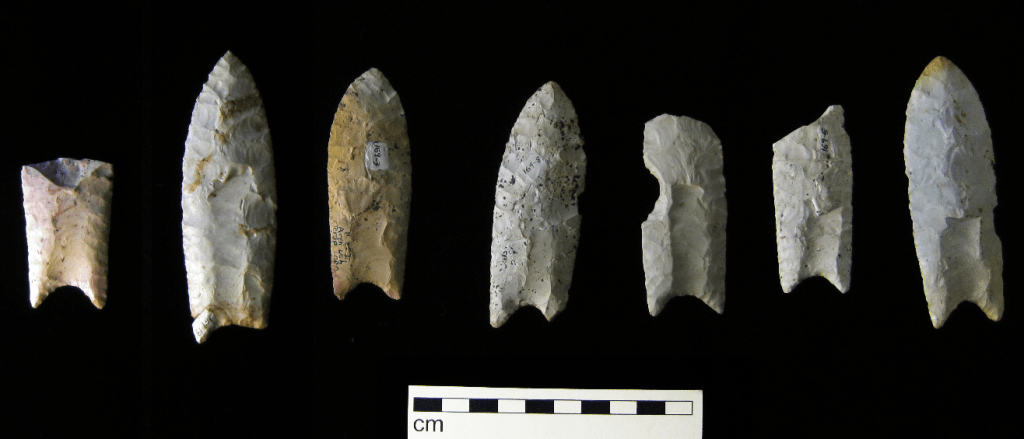
Some examples of Clovis points from the Iowa site of Rummels-Maske, shared by Wikimedia contributor Billwhittaker.
Whatever the case, as the ancestors of Native Americans moved into the Americas, they entered a world untouched by hominids with a quarter of the planet’s total land area open for the taking. They undoubtedly filled North America with a miscellany of regional economies from coastal fishing communities to interior megafauna-hunters and forest-managers. For the over 10,000 years that humans were in the Americas before the megafauna extinctions, we can infer an already incredible diversity of human culture and innovation, most of which only exists in fragments in the archaeological record. Keep in mind that in prehistoric archaeology, when we refer to “cultures,” we are not referring to the cultural identity categories of people groups since we do not have access to that sense of self-understanding they had for themselves. Instead we are referring to assemblages of material objects that show similar cultural manufacturing and use practice. The Clovis culture of 13,050 to 12,750 years ago is one of these such material cultures, characterized most famously by the Clovis stone projectile point, named after the site in New Mexico where the style was first identified. These points are found across the North American continent from the Pacific to the Atlantic in a relatively narrow band of time. Since we now know that this culture does not represent the very first Americans, it means that it is representative of another incredible process: long-distance cultural interaction. The rapid distribution of one specific tool technology implies that societies across North America engaged in long-distance trade and movement and had the population level and social complexity to facilitate these activities.
There is no doubt that Clovis points were used for hunting large animals. They are often inaccurately referred to as arrowheads (archery would not be practiced in North America until around 8,000 years ago) and are more properly the heads of spears and javelins, measuring between about 7 and 11 centimeters in length. Compilation studies of Clovis sites tend to find evidence that local food economies across North America made heavy use of large-animal hunting. It is not unreasonable to suggest that the technological development and rapid spread of Clovis points within North America related to the presence of the continent’s bountiful megafauna and the opportunities that came with hunting them more effectively. Hunter-gatherer societies often prioritize the hunting of large animals because of the amount of food they provide, which can help to feed fairly large groups of people all together. Even if developments in archaeology have caused overkill proponents to lose the seemingly excellent timing of the peopling of the Americas, the explanation for the extinction of the megafauna remains on the table due to the fact that humans clearly made use of these animals and before the extinctions were developing technology for it.
Below is data from Waguespack and Surovell 2003 showing the percentages of Clovis-period archaeological sites from a dataset of 33 that certain animal remains appeared at.
| Proboscidean | 79% |
| Bison | 52% |
| Other Ungulate | 45% |
| Other Rodent | 39% |
| Turtle/Tortoise | 30% |
| Bird | 30% |
| Equid | 27% |
| Muskrat | 27% |
| Lagomorphs | 24% |
| Fish | 24% |
| Camelid | 21% |
| Other Carnivore | 21% |
| Snake | 18% |
| Amphibian | 18% |
| Peccary | 15% |
| Insectivore | 12% |
| Sloth | 9% |
| Bear | 9% |
| Armadillo | 9% |
| Alligator | 6% |
| Tapir | 3% |
| Glyptodont | 3% |
In a 2003 review of animal remains at Clovis sites (Waguespack and Surovell), data was compiled to investigate the dietary trends across the continent, tallying up the percentages of these sites at which different types of animals appeared. By far the standout was proboscideans (mammoths and mastodons) which were present at 79% of sites. Bison followed up at 52% of sites, showing that they likewise were an important part of Pleistocene Native American diets, just as many of these people’s more recent descendants have consumed large amounts of bison. Miscellaneous ungulates such as deer occur at 45% of sites. Other animals occur at lower rates and are more regionally prevalent. Plenty of small animals like turtles and tortoises (30%), birds (30%), lagomorphs (that is, rabbits and hares; 24%), and fish (24%) can be found aside from the megafauna. Some of the famous extinct megafauna do occur at very low rates such as miscellaneous carnivores including big cats (21%), sloths (9%), and glyptodonts (3%). The data is fascinating as it at once seems to answer questions while also leaving others unanswered. Mastodons and mammoths account for such an overwhelming presence in these archaeological sites that it is very easy to understand that widespread human hunting of these massive meat-filled creatures probably put significant pressures on their populations. At the same time, bison, which follow them up, are very much still alive today (though a few species of North American bison have gone extinct) and many extinct animals such as ground sloths and glyptodonts do not seem to have been significantly hunted very often. The frequencies with which these Late Pleistocene humans hunted animals seems, vexingly, to not correlate strongly by itself with which animals went extinct.
So, amidst all of this, what did happen?
The Living and the Dead
No doubt as I have presented the climatic and overkill camps, certain readers have noticed the Columbian mammoth in the room, which is that there is nothing that prevents the climatic and anthropogenic explanations from being both true. And indeed, the reality is that specialists studying these phenomena largely see it to be a combination of factors. In the light of massive amounts of evidence from fossil bones, genetic data, frozen remains, ice cores, orbital mechanics, and human cultural remains, the reality is that the debate today is not whether animals suffered at the expense of climate change or human presence but rather the proportionality of one to the other in making for the breaking point of populations. Interpretations of the data vary and more is being found all the time.
But first there is another… perhaps mastodon in the room. I have limited this discussion to North America, which is an easy region to discuss in relation to the spread of Homo sapiens and which had the most dramatic movement of ice sheets over the course of the Pleistocene. But often you will hear the “Late Pleistocene extinctions” referred to collectively with eyes also on Australia, Europe, and the Eurasian Steppe. All of these have their own unique dynamics. Australia was never subject to glaciation in the Pleistocene and its subtropical megafauna died out for the most part much earlier, such as the massive wombat relative Diprotodon around 40,000 years ago. Humans entered Australia around 65,000 years ago and the development of land management through controlled burning has been proposed as an explanation for the additional pressure on the megafauna. Many of the animals on the continent that are now extinct survived much later, including the famous thylacine which I have dedicated another article to on this site. Europe and the Eurasian Steppe had extinctions timed similarly with those in North America. The vast Mammoth Steppe contracted as permafrost receded in the soil and thick forests grew in throughout the northern part of the Eurasian continent. Eurasia had been home to other members of genus Homo before sapiens such as the Neanderthals, who were already hunting megafauna in Europe and Western Asia before our ancestors left Africa. By the Late Pleistocene though, massive structures made of mammoth bones in Ukraine signal that whole local economies centered around megafauna. For this region of the world, the same questions of climate vs. humanity are deeply rooted in discourse. Perhaps another time this blog will explore these other areas of the world on this issue.
Below is, after all my research for this piece, how I understand the extinction of the North American megafauna. It is an account that is not too far from what scientists tend to think but which might have some disagreement with one specialist or another, because this is an issue where general understandings exist but disagreements appear when you zoom in on given details.
For hundreds of thousands of years, the North American megafauna thrived. The periodic advance and retreat of the ice sheets created geographical disruptions over the course of the Pleistocene. When the ice sheets were at their maximal extent, they isolated much of North America from Beringia but during the waxing and waning of the glaciation, there were extended periods when the Eurasian Steppe and North America actively exchanged migrating animals. During interglacials, many megafauna populations were stressed as changing environments reshuffled them around as they followed suitable habitats. However, the size and ecological diversity of North America meant that there were almost always pockets where species could thrive and rebound from, making extinction rare. The animals that could survive one interglacial could probably survive the next. Around 25,000 years ago, during a particularly cold part of the Pleistocene, the ancestors of today’s Native Americans propagated in Beringia and some of them made use of the Pacific maritime bounty to live in coastal communities on the coastlines that over generations spread southwards until they passed south of the ice sheets and into the North American heartland. There they propagated and spread quickly but population densities remained relatively low for most of the rest of the glacial phase. These people hunted megafauna but were not numerous enough to cause dramatic population disruptions. Over 13,000 years ago, changes in the Earth’s reception of sunlight in accordance with the Milankovitch cycles was causing a warming trend that had seen the ice sheets retreating for some time. Indigenous people, increasing in numbers, perfected the Clovis points to more effectively hunt game and, as their societies had gained significant size and complexity, trade and learning interaction distributed them quickly across the continent. These larger societies perhaps also practiced land manipulation such as burning to increase their food production which affected the biosphere significantly where humans were. As the usual reshuffling of habitats of an interglacial occurred, populations of certain animals took a hit, but these were exacerbated by the highly effective human hunters, who also in some cases diminished the habitats megafauna relied on. The result was an ecological cascade. Some such as mammoths and mastodons may have been hunted out while other animals lost out to more indirect effects. Predators that specialized in certain large prey like saber-toothed cats likely suffered as the prey they fed on fell into decline. The tipping point was what ecologists call a regime shift, a radical shift in the balance of organisms within an ecosystem, which can be spurred on by the loss of keystone species. Large herbivores manage natural landscapes and modulate the habitats for others and their disappearance may have extended the decline to species that humans hardly even hunted.
10,000 years ago, the Holocene began. The last of a whole array of large animals in North America disappeared. Away went the mammoths, the mastodons, the ground sloths, the glyptodonts, the western horses, the camels, the American lions, the saber-toothed cats, the dire wolves, the short-faced bears, and more. But as the order changed, some continued to live and even thrive. Grizzly and black bears foraged in brush and caught salmon. Moose, elk, and a whole variety of deer moved through the woods and plains. Bison herded across the plains in the center of the continent in the millions. Cougars disappeared for a time but came back from the South America. The world was warmer and while it was missing its great and ancient denizens, life continued on. Native Americans propagated in the continent, developing a whole wealth of lifeways and economies, cultures that would continue for thousands and thousands of years. The Earth, as it always does, carried on, storing away its treasures in ice, rock, and even liquid asphalt for us to someday wonder about how forces of change play out over very long times.
Further Academic Reading
- Bargo, M. Susana; De Iuliis, Gerardo; and Vizcaíno, Sergio F. “Hypsodonty in Pleistocene ground sloths.” Acta Palaeontologica Polonica 51(1), 2006: 53-61. https://doc.rero.ch/record/13481/files/PAL_E257.pdf
- Bennett, K. D. “Milankovitch cycles and their effects on species in ecological and evolutionary time.” Paleobiology, 16(1), 1990: 11-21. https://www.researchgate.net/profile/Keith-Bennett-2/publication/258240701_Milankovitch_cycles_and_their_effects_on_species_in_ecological_and_evolutionary_time/links/5822ef7e08ae7ea5be71b912/Milankovitch-cycles-and-their-effects-on-species-in-ecological-and-evolutionary-time.pdf
- Bretz, J. Harlen. “The Lake Missoula Floods and the Channeled Scabland.” The Journal of Geology 77(5), 1969: 505-543. https://wpg.forestry.oregonstate.edu/sites/default/files/seminars/1969_Bretz.pdf
- Broeker, Wallace S. et al. “Putting the Younger Dryas cold event into context.” Quaternary Science Reviews, 29, 2010: 1078-1081. Putting the Younger Dryas cold event into context (researchgate.net)
- Clark, Peter U. et al. “The Last Glacial Maximum.” Science, 325, 2009: 710-714. PAL_E4267.pdf (rero.ch)
- DeSantis, Larisa R. G. et al. “Implications of Diet for the Extinction of Saber-Toothed Cats and American Lions.” PLoS One, 7(12), 2012. deb_pone.0052453 1..9 (plos.org)
- Dulik, Matthew C. et al. “Mitochondrial DNA and Y Chromosome Variation Provides Evidence for a Recent Common Ancestry between Native Americans and Indigenous Altaians.” The American Journal of Human Genetics, 90(2), 2012: 229-246. Mitochondrial DNA and Y Chromosome Variation Provides Evidence for a Recent Common Ancestry between Native Americans and Indigenous Altaians (cell.com)
- Enk, Jacob et al. “Complete Columbian mammoth mitogenome suggests interbreeding with woolly mammoths.” Genome Biology 12(R51), 2011. https://link.springer.com/content/pdf/10.1186/gb-2011-12-5-r51.pdf
- Eren, Metin I. et al. “North American Clovis Point Form and Performance: An Experimental Assessment of Penetration Depth.” Lithic Technology, 2020. North American Clovis Point Form and Performance: An Experimental Assessment of Penetration Depth (nsf.gov)
- Erlandson, Jon M. et al. “Ecology of the Kelp Highway: Did Marine Resources Facilitate Human Dispersal From Northeast Asia to the Americas?” The Journal of Island and Coastal Archaeology, 10(3), 2015: 392-411. https://www.researchgate.net/profile/Kristina-Gill-2/publication/273509712_Ecology_of_the_Kelp_Highway_Did_Marine_Resources_Facilitate_Human_Dispersal_From_Northeast_Asia_to_the_Americas/links/55074dfa0cf26ff55f7cdadf/Ecology-of-the-Kelp-Highway-Did-Marine-Resources-Facilitate-Human-Dispersal-From-Northeast-Asia-to-the-Americas.pdf
- Goodyear, Albert C. “Evidence of Pre-Clovis Sites in the Eastern United States.” Paleoamerican Origins: Beyond Clovis, 2005: 103-112. Evidence of Pre-Clovis Sites in the Eastern United States (sc.edu)
- Marshall, Larry G. “Land Mammals and the Great American Interchange.” American Scientist 76, 1988: 380-388. https://www.academia.edu/download/33183172/Marshall_88.pdf
- Mix, Alan C; Bard, Edouard; and Schneider, Ralph. “Environmental processes of the ice age: land, oceans, glaciers (EPILOG).” Quaternary Science Reviews 20, 2001: 627-657. https://www.academia.edu/download/44452090/Environmental_processes_of_the_ice_age_l20160405-13417-1nssg8v.pdf
- Moleón, M. et al. “Rethinking megafauna.” Proceedings of the Royal Society B: Biological Sciences, 287(1922), 2020. Rethinking megafauna | Proceedings of the Royal Society B: Biological Sciences (royalsocietypublishing.org)
- Larramendi, Asier. “Shoulder Height, Body Mass, and Shape of Probiscideans.” Acta Palaeontologica Polonica 63(3), 2015: 537-574. Shoulder Height, Body Mass, and Shape of Proboscideans (bioone.org)
- Paijmans, Johanna L. A. et al. “Evolutionary History of Saber-Toothed Cats Based on Ancient Mitogenomics.” Current Biology, 27(21), 2017: 3330-3336. Evolutionary History of Saber-Toothed Cats Based on Ancient Mitogenomics – ScienceDirect
- Perri, Angela R. et al. “Dire wolves were the last of an ancient New World canid lineage.” Nature, 591(7848), 2021. https://orbi.uliege.be/bitstream/2268/255832/1/NatureDireWolves_authorversion.pdf
- Rubincam, David Parry. “The Precession Index, A Nonlinear Energy Balance Model, and Seversmith Psychroterms.” NASA, 2004. The Precession Index, A Nonlinear Energy Balance Model, And Seversmith Psychroterms – NASA Technical Reports Server (NTRS)
- Sorkin, B. “Ecomorphology of the giant short-faced bears Agriotherium and Arctodus.” Historical Biology, 18(1), 2006: 1-20. https://www.academia.edu/download/35338104/Short-faced_bears_paper.pdf
- Tomassini, Rodrigo Leandro et al. “First osteological and histotaphonomic approach of Equus occidentalis Leady, 1865 (Mammalia, Equidae) from the late Pleistocene of Rancho La Brea (California, USA).” PLoS One 16(12), 2021. https://journals.plos.org/plosone/article/file?id=10.1371/journal.pone.0261915&type=printable
- Waguespack, Nicole M. and Surovell, Todd A. “Clovis Hunting Strategies, or How to Make Out on Plentiful Resources.” American Antiquity, 68(2), 2003: 333-352. https://www.academia.edu/download/6611850/waguespack_and_surovell_2003.pdf
- Wright, Tom. “Geological Setting of the Rancho La Brea Tar Pits.” Petroleum Geology of Coastal Southern California, 1987: 87-91. AAPG Datapages/Archives: Geological Setting of the Rancho La Brea Tar Pits
Living in the Longue Durée is part of the History Nerds Network, a group of friends who together make history content online. Check out our Discord server here if you’d like to chat with us: https://discord.gg/dzdrzUpKeG You can also follow for post updates on the Facebook page ( https://www.facebook.com/profile.php?id=61559902349797 ) or on Instagram at @livinginthelongueduree .
Consider supporting my time and money investment into research on Patreon if you want to allow articles like this to maintain their quality and regularity: Living in the Longue Durée | A thoughtful and eclectic history blog. | Patreon


 Living in the Longue Durée

Leave a reply to Rue Ryuzaki Cancel reply