The world, and the universe that contains it, is big. Very big. And in classical physics of course aside from the three dimensions this size is defined in, there exists the fourth dimension of time. All objects are positioned somewhere in the three spatial dimensions and in the temporal one, which specially acts as a means through which the object can occupy different locations in the spatial dimensions in a sort of sequence. Causality itself is subject to the distance limits of space-time and so every process happens in relation to place and time, localized in the two but part of a much greater whole.
Is there a way to look at the world and experience and learn from this in such a manner that can give greater meaning and context to our entire material existence?
To Observe History in Place
Let’s try to take in the amount of history that can be experienced in one simple space’s line of view.
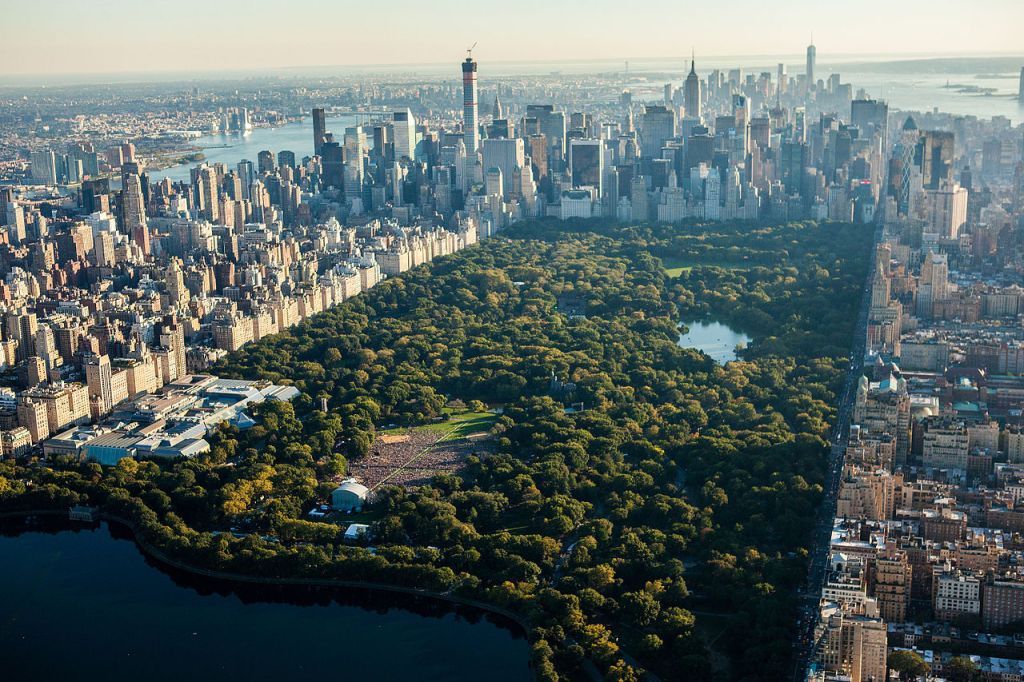
Picture yourself in a major modern city. Let’s say downtown Manhattan, New York City. You’re in Central Park by the statue of Alexander Hamilton to the south of Jacqueline Kennedy Onassis Reservoir (Central Park’s largest body of water) and across East Drive from the Metropolitan Museum of Art. If you face Hamilton from the road, behind him is a row of trees and behind those is an array of baseball diamonds on a great lawn, which is called the Great Lawn. It’s a sunny summer day with a blue sky speckled by a few white wispy clouds and Central Park is packed with people, local and visiting, emitting a cacophony of languages, music, and the laughs of pleasant meetings. Central Park will be there if you come back tomorrow and probably if you come back in 20 years. Some semblance of it may grace your transhumanist eyes even if you come back in 200 years. But it will be a little different and indeed it always has been. Central Park hasn’t always been there.
As you might know from the biographical musical about him that still plays on Broadway in that same city, Alexander Hamilton is considered one of the “founding fathers” of the United States. Like the canonization of a saint, this title does not really objectively describe his place in history but rather formalizes how later Americans have understood him as key to the sculpting of their republic and identity, something which can gloss over the sheer political controversy he had in his day, from sex scandal to bank consolidation. The historian can know a lot about Hamilton and his life but just as interesting, and perhaps more pertinent to the presence of the statue in this park, is the question of Hamilton’s reputation in his afterlife and why it is what it is, beyond merely his own actions. Founding fathers, for American cities and states on the Eastern Seaboard, are narrative anchors to focus local presence into that great historical and mythological epic of the founding of the United States, just as the notable poleis of ancient Greece all seemed to have had some hero present in the Trojan War. Alexander Hamilton in many ways represents New York, having played a significant role in defining it as the US’s great international economic capital, a role which has only increased in global prominence in the following centuries. When the statue was erected by the City of New York in 1880, 76 years after its subject’s death, it was dedicated so as to represent his presence in that place and therefore the place’s place in America.
To the south and down the road, a very different object of historical flashiness, an authentic Egyptian obelisk, pokes up high into the sky. This is Cleopatra’s Needle, which is named incorrectly, sort of. The obelisk was commissioned by the pharaoh Thutmose III in 1475 BC (a date which can be gleaned from a reference to the regnal year in the hieroglyphs) and erected at the Egyptian city the Greeks would later call Heliopolis. Nearly a millennium and a half later, the Ptolemaic pharaoh Cleopatra VII (whom you have most certainly heard of), moved the monument, along with another obelisk which is now in London and similarly called Cleopatra’s Needle, to a temple in Alexandria, the capital of Egypt in the classical period. Thus, wildly, the majority of this object’s history has been spent decorating a city that it was not sculpted for–and this was not even New York, which it was moved to in 1881 after being gifted to the United States several years before by the Khedivate of Egypt which was happy to keep the US as a neutral party amidst the conflicts between Britain and France for influence in the region. On the timescales of antiquity, modern history shrinks into a tiny chronological blip. Despite the two being separated by a millennium and a half, Thutmose III was slightly closer in time as well to Cleopatra VII than he was to Egypt’s first unifying king (pharaoh is a title of the New Kingdom and later) Narmer who ruled around 3100 BC. Across the way from Cleopatra’s Needle in the Met is the Temple of Dendur, an Egyptian sanctuary transported in whole to the United States and dating in completion to 10 BC, 20 years after Cleopatra’s death and depicting the Roman emperor Augustus as pharaoh. The use of Middle Egyptian religious writing derived from the Egyptian language as it had existed nearly 2,000 years before celebrates a Roman sovereign. Many eras crash into one another in this fascinating space from some of the earliest great kingdoms in the world to the grabby imperialists of the industrial age.
But what about the ground itself? New York’s Central Park is right in the middle of Manhattan Island, a natural but heavily expanded strip of land. Throughout the park, large outcroppings of the metamorphic rock schist jut forth in great whitish-grey promontories. Between about 335 and 200 million years ago, the world map was dominated by Pangaea, a vast supercontinent which was comprised of all of the world’s major continents of today. The Atlantic Ocean did not exist and eastern North America was pressed up against the coast of North Africa with the Appalachian and Atlas mountain ranges being now the remains of a single central Pangaean range. The schist that now dots Central Park was born in the intense geological conditions at this confluence of continents. In the Triassic Period (252-200 million years ago), as the continental drama began to push the landmasses apart, much land descended down into the new rift valley and the future waterways around New York City began to form. Hundreds of millions of years on as the world came into the grip of an ice age, future Central Park would be sculpted by the gargantuan mass of the Laurentide Ice Sheet, an extensive glaciation that formed and receded several times within the past 2.58 million years, covering at times most of Canada and the northern strip of the eastern United States. New York’s geography has been dredged intensely by these huge amounts of ice. In fact, Long Island is essentially a very large strip of sediment pushed to the extremity of the ice’s advance. But in Central Park, it’s the striations on the schist that tell the story of the ice age as the massive glaciers pulled smaller rocks and moving waves of ice across the surface below. After 10,000 years ago when our interglacial phase was in place, Manhattan Island was filled with trees and forest. When European settlers mapped the area in the 1600s, it was home to the Lenape, who were themselves divided into several smaller local groups. Native Americans inhabited the area for millennia and with widespread practice of three-sisters agriculture (squash, corn, and beans grown together), the environment was far from “natural” even when Europeans arrived. The island experienced significant expansion in the modern period as intense urbanization expanded the coasts out into the water and construction and infrastructure ensured that large areas of ground were moved or rebuilt or otherwise shaped.
So from one spot in our real world, we can see evidence of the founding of the United States and the history of how New Yorkers have looked back on one of their local heroes, we can see multiple periods of Egyptian history layered together as well as the age of scientific imperialism that brought them to the wider world, and we can see the intense geological history in the landscape stretching back before even the dinosaurs roamed the area. This isn’t a particularly special spot in this regard. Our world is full of history and details interact with larger events where the moment of the present inevitably and universally conserves some memory of the past. On this blog, we are living in the longue durée by thinking about everything around us in terms of the passage of time. It is a form of intellectual mindfulness that enhances the experience of the world.
Welcome to the Blog
So welcome to the blog. Most articles won’t be like the above but it is an interesting thought exercise for how I believe history is most excitingly engaged with. The arena of history is of course here, our world. Therefore, it is up to our attentiveness and interest to explore even those things which sometimes evade the label of history and find how they fit into the larger story.
On this blog, as above, when I use the word “history,” I am using a relatively non-bounded definition. Traditionally, history was that material of the past which was recorded in the written (or orally transmitted) word but today our understanding of our story is informed by so many diverse disciplines from archaeology to linguistics to paleontology to paleoclimatology to cosmology and more. Therefore in the casual sense, it tends to make sense to use a fairly inclusive usage of the word “history” for the general interest in the past. On this blog, we may talk about the history of the early universe 13.7 billion years ago. Even this is part of the same story. Very little would look the way it did in Central Park without the rapid inflation of the early universe.
Generally topics will be assorted historic topics which are far more bounded and sourced than the above. I will usually try to emphasize time and space as needed context because I believe that they are key to making sense in anything in history. These articles will also appeal to the senses and hopefully help the reader to imagine what things were like in a given place and time, using what we can learn in the present to reconstruct the past. A new article will be posted, time permitting, on the Sunday of every week.
This blog is affiliated with the History Nerds Network, a community of friends who produce history and other content together. Consider checking out our podcasts Podding Through Time, Podding Through Religion, and History Nerds Conversation Parlour.
Thanks for reading and happy life-long learning.
Central Park image taken from Wikimedia.
Consider supporting my time and money investment into research on Patreon if you want to allow articles like this to maintain their quality and regularity: Living in the Longue Durée | A thoughtful and eclectic history blog. | Patreon


Leave a Reply